Amazon-ML-Entity-Resolution
3 · Results and lessons
← 2 · How it works · Next: 4 · Run it yourself →
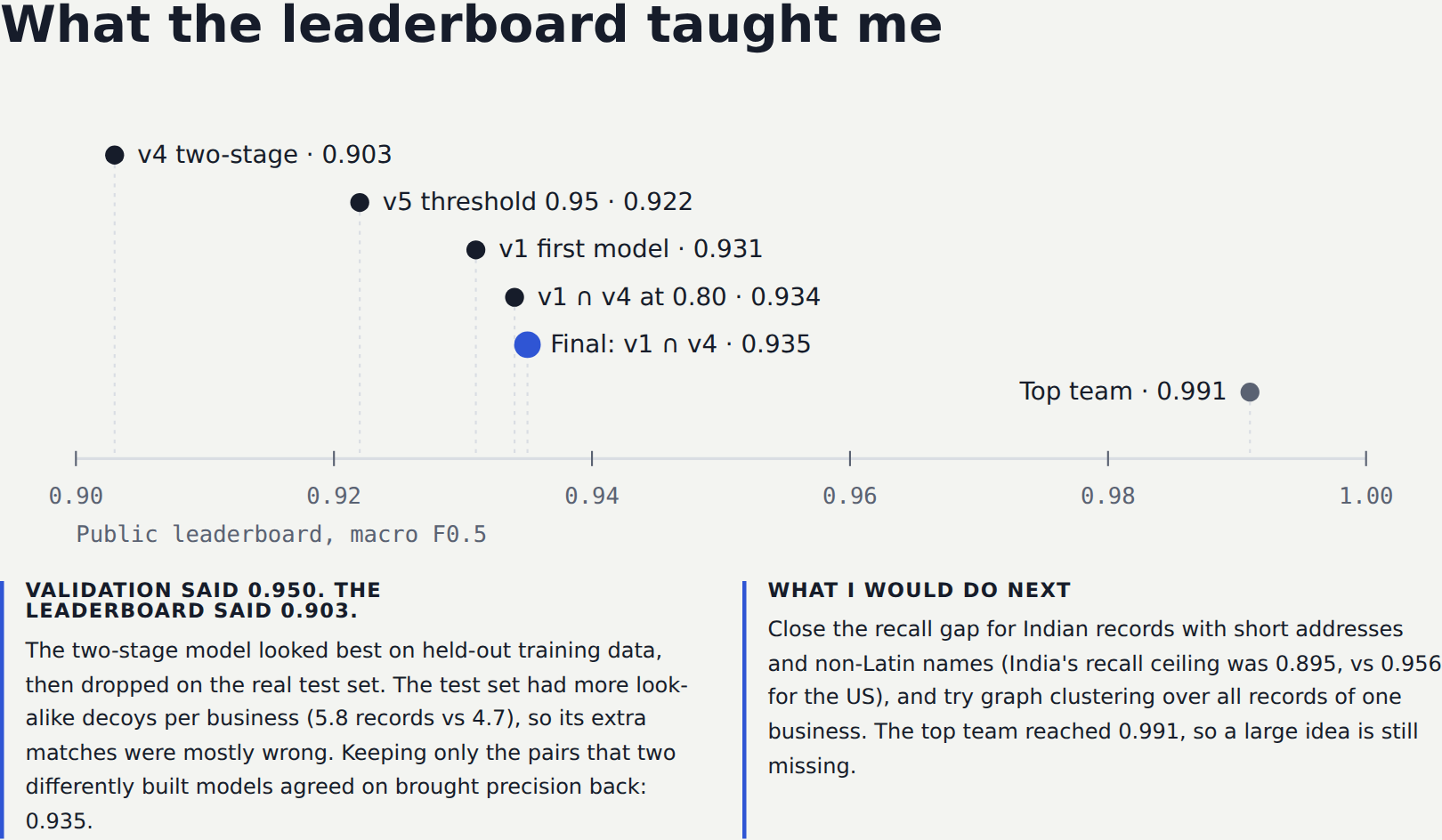
Every submission
| Version | What changed | Candidates / business | Validation F0.5 | Public leaderboard | |—|—|—|—|—| | v1 | blocking (8 key types) + one LightGBM | 24.3 | 0.940 | 0.931 | | v4 | + learned pruning, competition, frequency and phonetic features | 4.46 | 0.950 | 0.903 | | v5 | v4 model, stricter threshold 0.95 | 4.46 | — | 0.922 | | v1 ∩ v4 at 0.80 | agreement, with v4 stricter | 4.46 | — | 0.934 | | Final | keep only pairs both v1 and v4 predict | 4.46 | — | 0.935 |
The top score on the leaderboard was 0.991. I didn’t make the Top 500.
Lesson 1: a validation score is a hypothesis, not a result
v4 beat v1 on validation (0.950 vs 0.940) and then lost on the leaderboard (0.903 vs 0.931).
Comparing the two submission files showed why. v4 predicted 586,000 extra pairs, about 9% more matches per business, and on the test set most of them were wrong. The test set has more Source-2/3 records per business (5.8 vs 4.7 in training), so there are more look-alike decoys. A threshold tuned on training data was too trusting on test.
What worked: keeping only the pairs that two differently built models agreed on. Each model makes different mistakes, so agreement filters out many of them.
Lesson 2: blocking decides your ceiling
A true match that blocking never proposes can never be predicted. The best possible recall was 0.956 for the US but only 0.895 for India, because Indian records often have short addresses and names in other scripts. The biggest remaining gains are there, not in the model.
Lesson 3: deciding what not to compare matters as much as the model
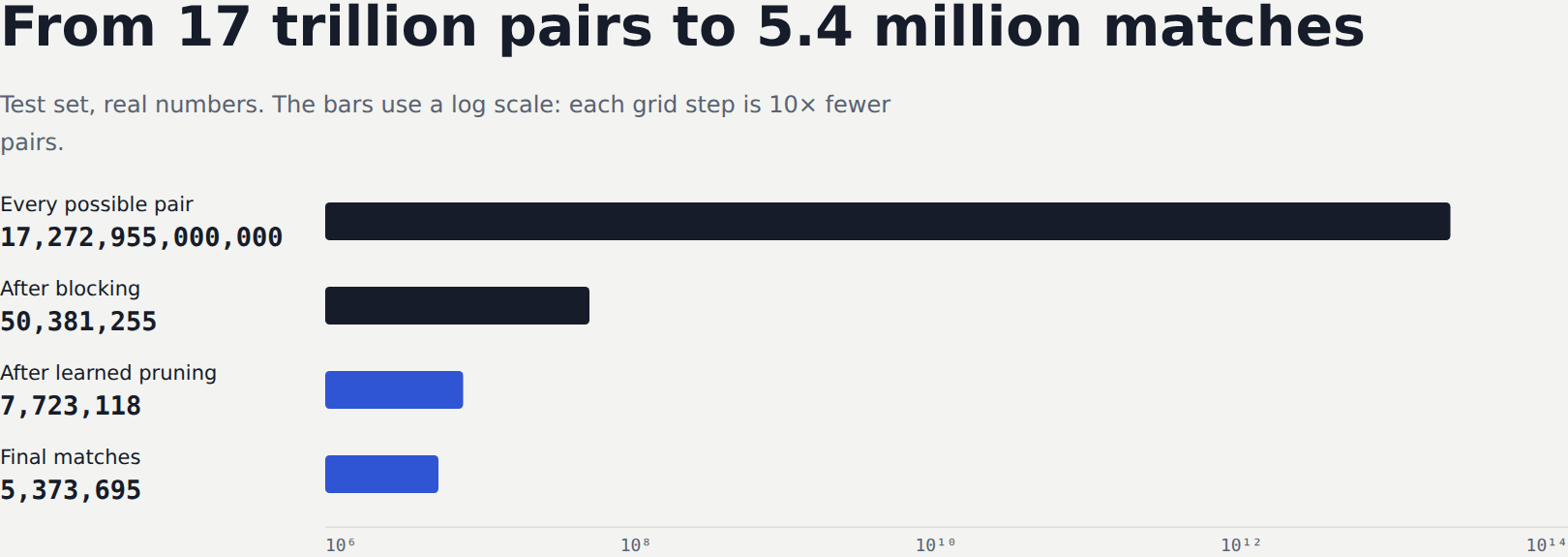
Learned pruning made the candidate set 5.4× smaller while losing only 0.4% of the reachable matches. At billion-record scale, that is the difference between feasible and impossible.
Lesson 4: engineering hygiene is part of ML
- Back up every output. A Colab reset erased an overnight run, and rebuilding it cost a morning.
- Save each stage to disk, so a crash doesn’t mean starting over.
- Keep a version history of every submission and the code that produced it.
Where the errors were
| Mistake | Typical example |
|—|—|
| Wrong merge | a near-identical name at the same address (Brightola vs Brightova Staffing Inc.) |
| Wrong merge | same name, house number off by one digit (1610 vs 161 Canal Dr) |
| Missed match | the record has an empty address and a common name |
| Missed match | a trade name unrelated to the legal name (Evowex for Noida Spinners Pvt Ltd) |
| Never proposed | an Indian-script name with an address shortened to “number, city” |
What I’d try next
- Better blocking for short Indian addresses: address-token pairs without numbers, and full transliteration to phonetic keys.
- A small multilingual embedding model (Apache-2.0) as an extra blocking and feature signal for trade names.
- Graph clustering: all S2/S3 records of one business should also resemble each other.
- Study the winning solutions to find the idea behind 0.99.